How to support writing and spelling (orthographic mapping) in students with dyslexia?

Authors: Mojca Poredoš, Milena Košak Babuder, Karmen Pižorn and Melita Lemut Bajec Faculty of Education, University of Ljubljana, Slovenia

After completing this lesson, you will be able to:  

  • understand the characteristics of dyslexia and the difficulties that learners with dyslexia face when writing;
  • apply techniques and strategies to support the writing process in learners with dyslexia;
  • analyze the language and language patterns to simplify students’ writing;
  • design individual materials to support specific students’ needs.

Information about the Topic – State of the Art, Formulation of the Teaching Problem

Definition of Dyslexia:

Dyslexia is the most researched disorder in the group of Specific Learning Difficulties (SLDs) and also the most common cause of reading, writing, and spelling difficulties. It extends along a continuum from mild to severe, and from short to lifelong (Magajna et al., 2008). It is an intrinsically determined disorder, and it stems from developmental or central nervous system specificities. It involves a group of diverse but interrelated factors that are part of the individual and affect their functioning throughout life (Raduly-Zorgo et al., 2010). Learners with dyslexia often have difficulties processing and remembering verbal information due to difficulties in verbal memory and verbal processing speed (BDA, 2010; Rose, 2009).

Dyslexia can affect the acquisition of different literacy skills, such as writing (BDA, 2010). Their writings therefore do not necessarily reflect a realistic level of knowledge and/or understanding of a language. So, it is important to equip learners with explicit strategies to improve their writing skills. While all learners benefit from this, it is of paramount significance for learners with dyslexia.  

Writing consists of writing individual words that form a foundation for sentences and longer paragraphs or narratives. Some tips on how to teach writing of individual words can be found in the Teaching Unit 1; the focus of this unit is on writing whole sentences and longer paragraphs.

Sentence formation is dependent on individual languages, which follow the predominant sentence structure. It is important to develop an understanding of words as building blocks of a language and formation of different types of sentences, such as interrogative, exclamatory, and declarative sentences. It is also crucial to support learners’ organizational skills and meta-cognition, especially meta-language, and foster memory and memory recall by offering different paths to access information.

Eventually, forming a coherent, complete written narrative can be challenging for learners with dyslexia. Therefore, it is important to equip them with strategies to logically organize their thoughts so that there is a clear transition between key ideas and relevant details when forming longer paragraphs.

What Can Be Done to Introduce a Change in This Field – To-Do’s and Tips

To develop writing skills, the following exercises can be used. However, they should be adapted to the language proficiency of the learners, their age, and their literacy development. This can ensure that the learning process is effective and tailored to their specific needs. The presented exercises can be also adapted for learners with blindness using Braille script and appropriate multi-sensory materials. Some of the following materials can be used.

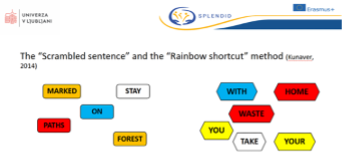
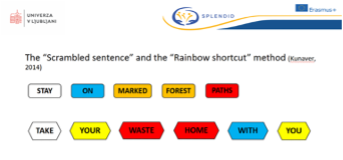
  • First, provide a story and/or a picture. Then, give learners a set of puzzle pieces with words and ask them to form one sentence or several sentences. If there are more sentences, you can later ask your learners to put them in the most logical order. To facilitate the process of learning and recalling of specific words or places of those words in a sentence it is useful to connect verbal information to multi-sensory representations, such as use of different colors, shapes, sizes, and different approaches to language learning, such as total physical response. After a means of multi-sensory representation is chosen, you have to be consistent in its use. These materials can also be used with the exercise known as scrambled sentences, shown in Figure 1.


Figure 1. The “Scrambled sentence” combined with the “Rainbow shortcut” method (Kunaver, 2014). 

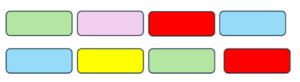
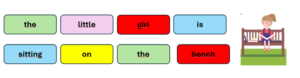
  • For more advanced learners, you can design a task in which the student has to fill in the gaps which are colored according to the set rules you provided before, shown in Figure 2.

Figure 2. Example of an exercise.

Before:

After:

  • For more detailed instructions, see the materials compiled within the SPLENDID project accessible under Deliverable T2.3 Good practices.
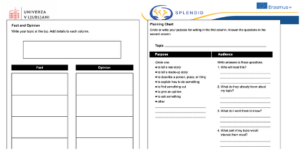
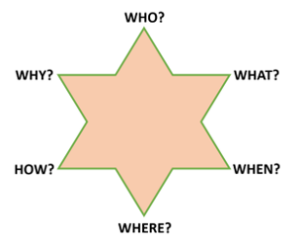
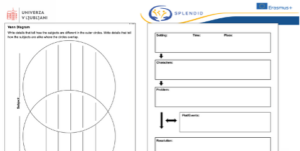
  • To support the writing of longer narratives, we can use different graphical organizers in the format of a template. First, the teacher needs to introduce the template and its use to the learners. Afterwards, learners choose the topic, plan their writing using the template, and start writing. Constant teacher support and feedback help them to improve their writing skills.
  • Types of different templates are for example (Figure 3):

– Step-by-step Chart 

– Sequence Chart 

– Flow Chart 

– Sandwich Chart

– Star Strategy Chart

– Spider Map 

– Describing Wheel 

– Mind Map

– Venn Diagram 

– Planning Chart

– Fact and Opinion   Strategy Chart

  • For younger learners, different shapes may be used as the template (i.e., a star, a flower, a sun, a snowflake, a butterfly, a tree).

Figure 3. Examples of templates.
Based on the video, discuss the following issues, dilemmas, concerns:

  • How do you support writing in multicultural and multilingual classes?
  • How do you follow children’s development in writing skills?
  • How do you adapt teaching writing to children with different learning needs and abilities?
  • How effective are graphic organizers for learners with dyslexia in your experience?
  • How can teachers encourage linguistic metacognition in writing in learners with dyslexia?
  1. British Dyslexia Association. (2010). What is dyslexia? – British Dyslexia Association. https://www.bdadyslexia.org.uk/dyslexia/about-dyslexia/what-is-dyslexia
  2. Kunaver, D. (2014) Angleščina – z rokami: Mavrična sestavljanka št. 1 iz zbirke Angleščina po mavrični bližnjici. Ljubljana: Samozaložba.
  3. Magajna, L., Kavkler, M., Čačinovič Vogrinčič, G., Pečjak, S. and Bregar Golobič, K. (2008). Koncept dela: Učne težave v osnovni šoli. Zavod Republike Slovenije za šolstvo.  
  4. Raduly Zorgo, E., Smythe, I., Gyarmathy, É., Košak Babuder, M., Kavkler, M., & Magajna, L. (2010). Disleksija – vodnik za tutorje [Dyslexia – A guide for tutors]. Univerza v Ljubljani, Pedagoška fakulteta.
  5. Rose, J. (2009). Identifying and Teaching Children and Young People with Dyslexia and Literacy Difficulties. DCSF Publications. https://apo.org.au/sites/default/files/resource-files/2009-07/apo-nid17897.pdf