
How to support phonological processing in students with dyslexia
Authors: Melita Lemut Bajec, Milena Košak Babuder, Karmen Pižorn and Mojca Poredoš Faculty of Education, University of Ljubljana, Slovenia
After completing this lesson, you will be able to:
- understand the characteristics of dyslexia and the difficulties that learners with dyslexia face with phonological and orthographical processing;
- apply techniques and strategies to support the learning process in learners with dyslexia;
- analyze the language and language patterns to simplify students’ phonological and orthographical processing;
- design individual materials to support specific students’ needs.
Information about the Topic – State of the Art, Formulation of the Teaching Problem
Definition of Dyslexia:
Dyslexia is the most researched disorder in the group of Specific Learning Difficulties (SLDs) and also the most common cause of reading, writing, and spelling difficulties. It extends along a continuum from mild to severe, and from short to lifelong (Magajna et al., 2008). It is an intrinsically determined disorder, and it stems from developmental or central nervous system specificities. It involves a group of diverse but interrelated factors that are part of the individual and affect their functioning throughout life (Raduly-Zorgo et al., 2010). Learners with dyslexia often have difficulties processing and remembering verbal information due to difficulties in verbal memory and verbal processing speed (BDA, 2010; Rose, 2009).
A significant aspect of dyslexia is a deficit in the phonological component of language, which manifests itself as a poorer ability to recognize, discriminate, and manipulate sounds in spoken language. Due to difficulties with phonological awareness, students with dyslexia often struggle to differentiate sounds, divide words into syllabus, recognizing onsets, rimes and phonemes, adding or removing sounds to form new words. Phonological awareness is also crucial for reading and spelling, since it affects the ability to learn how to match sounds and letters.
Phonological processing in the mother tongue and in the foreign language has been shown to be linguistically interdependent, meaning that phonological processing skills in one language predict word recognition skills within and across languages (Geva, 2000 cited in Nijakowska, 2016). This means that if a learner has phonological weaknesses in his or her first language, he or she is likely to have similar difficulties in the foreign language (Simon, 2000), with the intensity and nature of these difficulties depending on the language or its orthographic system.
The orthographic system of a language affects the learning of reading and writing in that language. Languages with shallow or transparent orthographic systems, such as Italian, Spanish, Finnish, Greek and Slovenian, where there is a consistent mapping of sounds and symbols, are more learner-friendly, while languages with deep orthographic systems, such as English and French, make it more challenging and difficult for learners with dyslexia to learn to read and spell in these languages (Nijakowska, 2016). In transparent languages, a single letter or sequence of letters is often pronounced in the same way, whereas in a non-transparent language, there are several different pronunciations. Similarly, a single phoneme may be spelled in different ways in non-transparent languages, while it is always spelled the same way in transparent languages (Frost & Ziegler 2007).
Further, individuals with dyslexia also have difficulties with orthographic awareness. These include recognitions of letter positions, combinations and sequences that make a word, familiar letter patterns within whole words or within words, the correspondence between sounds/phonemes and letters. These difficulties are more pronounced in languages where a single sound can be represented by more than one letter (e.g. bright) or different letter combinations in different words (e.g. try, time).
What Can Be Done to Introduce a Change in This Field – To-Do’s and Tips
If we want our teachers to be successful in inclusive settings and provide instruction that is appropriately tailored to the educational needs and abilities of learners with dyslexia (Washburn et al., 2011a), then they need to know the specifics of language learning in students with dyslexia and the principles of effective teaching approaches. This includes knowledge of language and literacy concepts, principles of explicit reading instruction, phonological awareness, orthographic awareness, and phonics (Nijakowska et al., 2018). In particular, pupils with dyslexia need phonological awareness training and multisensory learning. Prevention and early treatment are more effective than therapeutic interventions, which are most commonly used with pupils.
Note that it is essential to consider the language proficiency of the learners, their age, and their literacy development when selecting appropriate words for them to practice with. This can ensure that the learning process is effective and tailored to their specific needs.
To develop phonologic and orthographic awareness, the following exercises can be used. The presented exercises can be also adapted for learners with blindness using Braille script.
- Think of a story or use a story (such as one of the fairytales in the Reading with Phonics Collection) and read it by using a lot of visual and nonverbal support. Make sure that students understand the story and its’ main ideas. Then pay attention to selected words in the story you want to practice phonological and orthographical awareness with. These sounds should also be highlighted to draw learners’ attention. Take into account the position of a sound in a word and surrounding sounds which have an effect on the spelling of this sound. Using rhymes is particularly appealing, but also very beneficial to young learners. For example:
Exercise with /ɑː/ | Exercise with /æ/, /ɪŋ/ and / uː/ |
The pair were married on that day. (Kate smartly threw the wheel away.) And soon, they had a baby boy who filled their hearts with joy. (Sleeping Beauty, Reading with Phonics, Fennell, 2017) | ”I’d love to help him”cried the King. “That man sent all my favourite things.” He handed Dan a brand-new suit, A carriage and a snack to boot! (Puss in Boots, Reading with Phonics, Greening, 2017) |
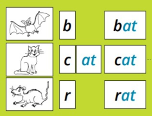
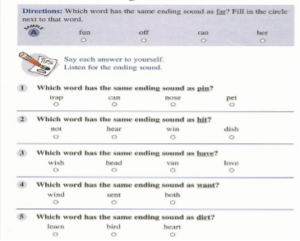
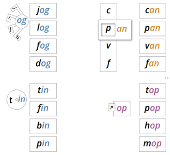
- Prepare materials (e.g., Handout – Picture 1, Cards – Picture 2, Handout – Picture 3, Straps – Picture 4 and 5) with spelling patterns. First, the educator pronounces the word. Then, the learner forms the correct word using the materials for each spelling pattern.
- Provide the learner with feedback, focusing on promoting listening and reading specific spelling patterns.
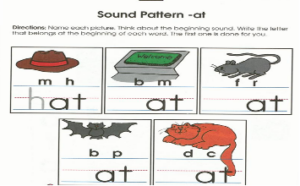
Picture 1. Example of the handout for practicing the sound /æt/; suitable for younger learners.
Source: American Education Publishing (1998)
Picture 2. Example of cards for practicing the sound /æt/; suitable for younger learners.
Source: Nijakowska et. al (2016)
Picture 3. Example of the handout for practicing phonological awareness in the ending sound; suitable for older learners.
Source: American Education Publishing (1998)
Picture 4. Examples of straps for practicing different sounds; suitable for older learners.
Source: Nijakowska et al. (2016)
Based on the video, discuss the following issues, dilemmas, concerns:
- How important is it to address the concept of orthographical transparency in multicultural and multilingual classes?
- How do you support phonological and orthographic awareness of learners in multicultural and multilingual classes?
- How do you follow children’s development in phonics skills?
- How do you adapt teaching phonics to children with different learning needs and abilities?
- American Education Publishing (1998). The Complete Book of Phonics. McGraw-Hill Children’s Publishing. https://aktoddlerschool.files.wordpress.com/2015/09/mcgraw-hill-the-complete-book-of-phonics-ages-4-9-jpr.pdf
- Fennell, C. (2017). Sleeping Beauty. Make Believe Ideas.
- Greening, R. (2017). Puss in Boots. Make Believe Ideas.
- Magajna, L., Kavkler, M., Čačinovič Vogrinčič, G., Pečjak, S. and Bregar Golobič, K. (2008). Koncept dela: Učne težave v osnovni šoli. Zavod Republike Slovenije za šolstvo.
- Nijakowska, J. (2019). The Handy Little Guide to Dyslexia: A practical guide to supporting dyslexic students in a foreign language classroom. Pearson. https://www.english.com/4aJpzQe5ynumrv3j/assets/2019/03/Dyslexia-in-the-classroom_web_compressed.pdf
- Nijakowska, J., Kormos, J., Hanusova, S., Jaroszewicz, B., Kálmos, B., Imréné Sarkadi, Á., Smith, A. M., Szymańska-Czaplak, E., Vojtkova, N., Alexiou, T., Košak Babuder, M., Mattheoudakis, M, & Pižorn, K. (2016). Dyslexia for Teachers of English as a Foreign Language: Trainer’s Booklet, Trainee’s Booklet, Test Booklet. DysTEFL2 Project.
- Raduly Zorgo, E., Smythe, I., Gyarmathy, É., Košak Babuder, M., Kavkler, M., & Magajna, L. (2010). Disleksija – vodnik za tutorje [Dyslexia – A guide for tutors]. Univerza v Ljubljani, Pedagoška fakulteta.
- Rose, J. (2009). Identifying and Teaching Children and Young People with Dyslexia and Literacy Difficulties. DCSF Publications. https://apo.org.au/sites/default/files/resource-files/2009-07/apo-nid17897.pdf